

Michelle Edhie Wahidin
Co-founder, Product @ NARU
Last updated
12 Nov 2026
Is banning young people from social media enough to keep them safe?
When Australia introduced its nationwide social media restrictions for under-16s, it sparked an important conversation about protecting young people online.
But protection raises another question: what happens when the platforms young people use to connect, explore their identities and find people who understand them are suddenly restricted?
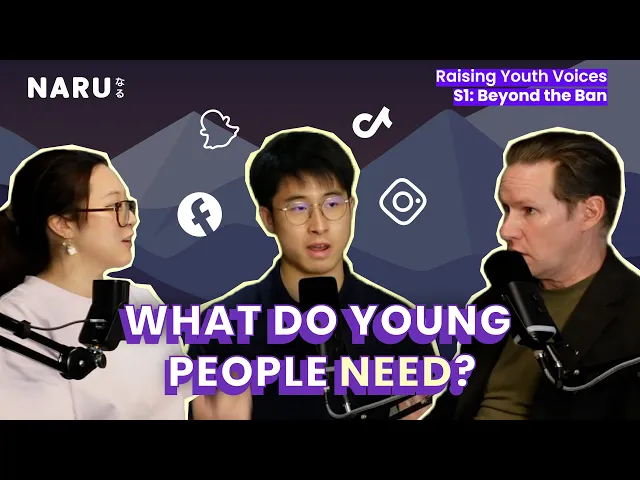
In the first episode of Raising Youth Voices: Beyond the Ban, NARU founder and host Michelle Edhie Wahidin brought together two perspectives that are often missing from conversations about youth and technology.
Joel Hines, an experienced youth facilitator and former school principal, shared insights from his work with young people. Mark Ong, a university student who grew up in Malaysia before moving to Australia, reflected on how social media shaped his relationships, identity and personal development.
Their conversation explored a question that goes beyond whether the ban is right or wrong: how can we protect young people online without overlooking what they need from the online world?
About the guests
Joel Hines is the Chief of Brands at The Youth Impact Foundation and Founder/Facilitator at Being Human. He has more than 25 years' experience working at the intersection of human development, education and wellbeing, spanning acute mental health settings, school leadership, rites of passage and emotional intelligence development.
Mark Ong is an undergraduate university student at The University of Melbourne. He currently works as a Marketing Intern at Ocean Greens and Lightning Ventures. In his spare time, he volunteers as EA Project Director at Enactus Melbourne.
1. The social media ban raises a question about whether young people were heard
One of Joel's first concerns when the ban was announced was whether young people had been consulted.
Having spent years working with children and teenagers, he understood that telling young people not to do something does not necessarily make them stop. It can even encourage them to find ways around the restriction.
He also questioned what young people themselves thought about the policy and whether their experiences had informed the decision.
During the conversation, Joel described a sense of silence surrounding the ban after its introduction. From his own experience, he had not observed a significant change in the way young people discussed or used social media.
That observation does not establish whether the legislation has succeeded or failed. It does, however, raise an important question: how do we know whether an intervention is working if we are not consistently listening to the people affected by it?
For Michelle, Joel and Mark, the issue was not simply about supporting or opposing restrictions. It was about making space for the perspectives that can be lost when decisions are made primarily from an adult point of view.
Young people experience digital platforms differently depending on their circumstances, relationships and communities. Understanding those differences is essential to any meaningful discussion about their safety.
2. Social media is more than entertainment. It is a place to belong.
It is easy to view social media primarily as a source of distraction, harmful content or excessive screen time.
But Joel offered another perspective: many young people use digital platforms because they want connection.
He recalled asking young people during his work with The Man Cave what they wanted their parents to worry less about. Their use of social media and computers was a recurring answer.
When asked why, the explanation was straightforward: these platforms were how they connected with friends.
For young people trying to understand who they are and where they fit in, that connection can be particularly important.
Social media allows teenagers to discover people with similar interests, participate in group conversations and feel part of something beyond their immediate surroundings.
For some, especially those who feel isolated in their physical environment, online communities can offer a sense of recognition they struggle to find elsewhere.
This does not mean every online interaction is healthy or that social platforms are free from harm. It means that removing access to a platform does not automatically remove the need it was meeting.
If adults want to help young people develop healthier relationships with technology, they need to understand what those young people are seeking online in the first place.
The question is not only what young people should be kept away from. It is also what helps them feel connected, accepted and supported.
3. For some young people, online and offline life are not separate worlds
Adults sometimes treat the digital world and the physical world as distinct spaces, with different expectations for how people should behave.
Joel challenged that distinction.
For many young people who have grown up with digital technology, online relationships are part of their everyday social lives. The people they communicate with online may be the same people they see in school, at sports practice or in their neighbourhood.
Mark's experience illustrates another dimension of that connection.
As an international student who moved from Malaysia to Australia, he relied on social media and video calls to maintain close relationships with his family. When he attended boarding school, homesickness was a significant challenge, and speaking with his parents regularly helped him stay connected to them.
Social media also became a tool for his professional development. Through creating content for startups, he used online trends and social platforms to learn about marketing, communicate ideas and help businesses reach audiences.
These experiences demonstrate that social media can serve several purposes at once: maintaining relationships, finding community, learning skills and exploring career opportunities.
For young people whose families live in different countries, or whose interests are not widely shared in their immediate environment, digital access can be especially meaningful.
This is why conversations about youth safety need to consider both the risks of online platforms and the relationships and opportunities they can support.
4. Belonging is different from fitting in
One of the most revealing moments in the episode came when Mark spoke about his experience at boarding school.
After moving to Melbourne, he struggled to fit into an unfamiliar environment. He felt culturally different from many of his peers and began looking for ways to earn their respect.
At his school, boarding houses competed against one another. Mark found that becoming a strong swimmer and runner helped him gain recognition.
This experience made some of the messages promoted by Andrew Tate appealing to him at the time, particularly the idea that men must prove their value to the world.
Mark worked hard to excel, partly because he wanted to be accepted. But an experience in a school running competition changed how he understood that need.
After training intensely for a 1,500-metre race, he finished fourth rather than achieving the result he wanted. He felt embarrassed and worried about what his friends would think.
Instead of rejecting him, his friends congratulated him.
That moment helped him recognise that their acceptance was not dependent on his winning.
Looking back, Mark explained that many boys are not necessarily looking for a particular influencer or ideology. They may be looking for reassurance that they are valued, that they belong and that they do not have to continually prove themselves to deserve acceptance.
Joel connected this experience to the distinction between fitting in and belonging.
Fitting in can mean changing your behaviour, hiding parts of yourself or wearing a social mask to gain acceptance. Belonging means being accepted for who you are.
For young people navigating identity and peer pressure, the difference matters.
When someone feels that acceptance depends on performance, popularity, appearance or status, messages that promise a path to recognition can become particularly attractive.
The solution is not simply to remove access to certain online personalities. It also involves creating environments where young people can develop a stronger sense of self-worth and experience acceptance without having to earn it through constant achievement.
5. Teaching digital literacy means teaching young people how to think
Restrictions can limit access, but they cannot replace the skills young people need when navigating information, relationships and technology.
Throughout the episode, the speakers returned to the importance of self-awareness, emotional regulation and critical thinking.
Mark described how meditation helped him become more aware of his behaviour online. By learning to stay present, he became better at noticing when he was scrolling without purpose and questioning whether that was how he wanted to spend his time.
He also spoke about recognising and accepting emotions rather than ignoring them.
These skills can help young people pause before reacting to content, reflect on what they are feeling and make more deliberate choices about what they consume.
The conversation also explored the role of algorithms and emotionally engaging content. Social platforms can expose users to material that makes them feel anxious, inadequate or pressured to keep up with other people's lives.
Mark described how seeing apparently successful people his age online sometimes made him question his own progress.
For him, learning that it was acceptable not to have all the answers helped reduce that pressure.
Joel extended the discussion to artificial intelligence and marketing. As AI-generated content becomes more common, young people need opportunities to question what they see rather than automatically accepting polished images, persuasive messages or seemingly authoritative content as reality.
Digital literacy, therefore, is not just knowing how to operate a device or recognise a dangerous website.
It also involves learning to ask:
What am I feeling as I consume this content?
Why might this post, video or advertisement affect me this way?
Is what I am seeing authentic, accurate or representative?
Am I making this decision because it reflects my values or because I want to fit in?
What do I want to do with the information I have received?
These questions help young people develop the judgement they will need throughout their lives, including when they eventually gain access to platforms from which they are currently restricted.
6. Young people need adults who listen, not just adults who set rules
Another important moment in the episode came when Joel described a workshop with young people in rural New South Wales.
His team had spent the morning trying to encourage participation, but the room remained silent. Eventually, one young person suggested that the adults leave for the afternoon so the students could speak more openly.
The team negotiated an opportunity to give the young people space to participate without the teachers present.
The conversations that followed revealed concerns and ideas that had not emerged earlier. Over the course of the programme, the students developed suggestions about their curriculum and timetabling that the teachers had not previously considered.
For Joel, the experience demonstrated the value of giving young people a genuine opportunity to contribute.
It also highlighted a distinction between inviting participation and creating the conditions in which participation feels worthwhile.
Young people can recognise when their opinions are unlikely to influence anything. If they repeatedly feel dismissed or ignored, they may stop contributing.
This has direct implications for policies affecting young people, including social media restrictions.
Consultation should not be a box-ticking exercise. It should give young people a safe environment to explain their experiences, challenge assumptions and contribute to solutions.
Adults may still need to establish boundaries and make difficult decisions. But those decisions can be better informed when young people have a meaningful role in the conversation.
7. What can parents and youth organisations do differently?
The episode did not suggest that every restriction should disappear or that every young person is ready to navigate the online world independently.
Instead, the speakers discussed ways adults can combine guidance, responsibility and opportunities for young people to develop their own judgement.
Here are four practical lessons from their conversation.
Start with curiosity, not condemnation
When a young person spends hours online or encounters troubling content, an immediate reaction might be to criticise their behaviour or take away their device.
But asking questions can reveal what is happening beneath the behaviour.
Try asking what they enjoy about a platform, how particular content makes them feel, or whether they have experienced pressure to behave differently online.
These conversations can help adults understand the young person's perspective before deciding how to respond.
Establish boundaries together
Joel described how his family developed a shared agreement around phone use, including a rule against using phones after 8 p.m.
The important detail was that the agreement applied to the family, not just the child.
Parents can discuss expectations, privacy, online behaviour, sleep and device use while modelling the same principles themselves.
Agreements can also be reviewed as young people demonstrate greater responsibility and their circumstances change.
Make room for offline connection
Joel advocated for face-to-face interaction through small groups, camps, holiday programmes, outdoor activities and other shared experiences.
Mark highlighted sports, meals and meaningful conversations with friends as activities he enjoyed away from social media.
These experiences can give young people additional opportunities to build relationships, explore interests and develop interpersonal skills.
The goal is not necessarily to replace every online interaction. It is to ensure that young people have multiple ways to experience connection and belonging.
Teach emotional awareness and critical thinking
Both guests emphasised the importance of helping young people understand their emotions and reflect on their decisions.
Parents and youth programme facilitators can create opportunities for reflection through everyday conversations, guided activities and age-appropriate mindfulness practices.
Rather than only telling young people what they should or should not do, adults can ask what they think happened, what they learned and what they might do differently next time.
Over time, these conversations can help young people develop the skills to make more informed decisions for themselves.
8. The goal should be safer digital experiences, not just restricted access
Australia's under-16 social media restrictions have brought youth safety into sharper public focus. But the discussion in this episode suggests that safety is a broader issue than platform access alone.
Young people need protection from harmful online experiences. They also need opportunities to build relationships, develop judgement, understand their emotions and feel accepted for who they are.
Those needs cannot be addressed through restrictions alone.
They require parents who model healthy behaviour, educators who teach digital literacy, youth organisations that create spaces for honest conversations, and decision-makers who take young people's experiences seriously.
The conversation also raises an important distinction between telling young people what to do and helping them understand why their choices matter.
Rules can establish boundaries. Education, reflection and supportive relationships can help young people understand how to navigate those boundaries and make decisions when adults are not present.
As Joel emphasised during the episode, adults need to look at their own behaviour, too. Young people learn from what the people around them do, not just what those people tell them.
Ultimately, the challenge is to create environments where young people can learn to navigate technology safely while still having opportunities to connect, explore and grow.
Final thoughts: Young people deserve a voice in decisions about their digital lives
One of Mark's closing messages was simple: it is okay not to know exactly what you want to do with your life. Every experience, including difficult ones, can offer something to learn.
That message reflects the broader conversation about young people and social media.
Young people are still developing, discovering their identities and learning how to navigate relationships. They need guidance, but they also need room to ask questions, make sense of their experiences and contribute their own ideas.
Protecting young people online should not mean overlooking their perspectives.
It should mean listening carefully, understanding their needs and working with them to build safer, healthier digital experiences.
That is why youth voices need to be part of the conversation, not an afterthought.
About the episode
This article is based on Episode 1 of Raising Youth Voices: Beyond the Ban, hosted by Michelle EW, featuring Joel Hines and Mark Ong.
The conversation covered Australia's under-16 social media restrictions, youth consultation, online belonging, identity, digital literacy, emotional awareness, artificial intelligence and the role of adults in supporting young people.
The article reflects the perspectives shared by the speakers. It is not a legal analysis of Australia's social media legislation or a substitute for independent research into the policy's outcomes.
Continue the conversation with NARU
At NARU, we believe the future of youth communities should be shaped by the people who understand young people's experiences best: young people themselves, alongside the parents, educators and organisations that support them.
Raising Youth Voices: Beyond the Ban brings together perspectives on youth safety, digital wellbeing, belonging and the changing role of technology in young people's lives.
Subscribe to our livestream events →
Listen to Raising Youth Voices: Beyond the Ban →
Are you a young person, educator, parent or youth organisation working through these questions? We want to hear your perspective.