🌟 Transforming Atomic Habits to Community Habits: Building Accountability Systems Gen Z Actually Uses

Greetings, Trailblazers! 🌟
In this 16th edition of the NARU Newsletter, we're exploring Atomic Habits (yes, the book by James Clear) - but making it community habit building. Why? Because people join communities for one reason: to change their lives.
But most communities fail at this step.
This article will explain why and the 3 principles that you can implement to make sure your members build core habits for transformation.
James Clear’s Atomic Habits sold over 25 million copies worldwide for one simple reason: it made habit formation feel achievable. But here’s what Clear didn’t explicitly address: What happens when you try to build habits alone?
The book’s core message: that tiny changes compound into remarkable results, resonated with millions of people trying to build better lives, 1% at a time.
Most people who read Atomic Habits experience the same pattern. They’re inspired. They design their environment. They stack habits. They track their progress. And for a while, it works. Then life gets messy. They miss a day. Then a week. Then they quietly abandon the habit altogether, feeling like they failed, when really, the system failed them.
The missing ingredient? Community.
Research shows that habits developed in isolation are significantly more fragile than those supported by social structures. When organizational psychologist Dr. James Hernandez studied habit formation across hundreds of participants, he found that the social dimension couldn’t be overstated, people building habits with peer support were exponentially more successful than those going it alone.
This is especially true for Gen Z, a generation that values accountability as one of their chief qualities when joining organizations, with nearly 75% saying accountability is important to them. They don’t just want to build habits, they want systems that hold them accountable while giving them autonomy.
So how do we take Clear’s brilliant individual framework and transform it into something that works for communities? How do we build “community habits” that Gen Z will actually stick with?
(In our previous article, we showed how cohort-based learning achieves 90% completion rates versus 3% for self-paced courses. Now let’s explore WHY that works through the lens of habit formation)
Let’s break it down.
What James Clear Got Right (And What He Didn’t Address)
Before we talk about community habits, let’s acknowledge what makes Atomic Habits so powerful.
The Core Principles That Work
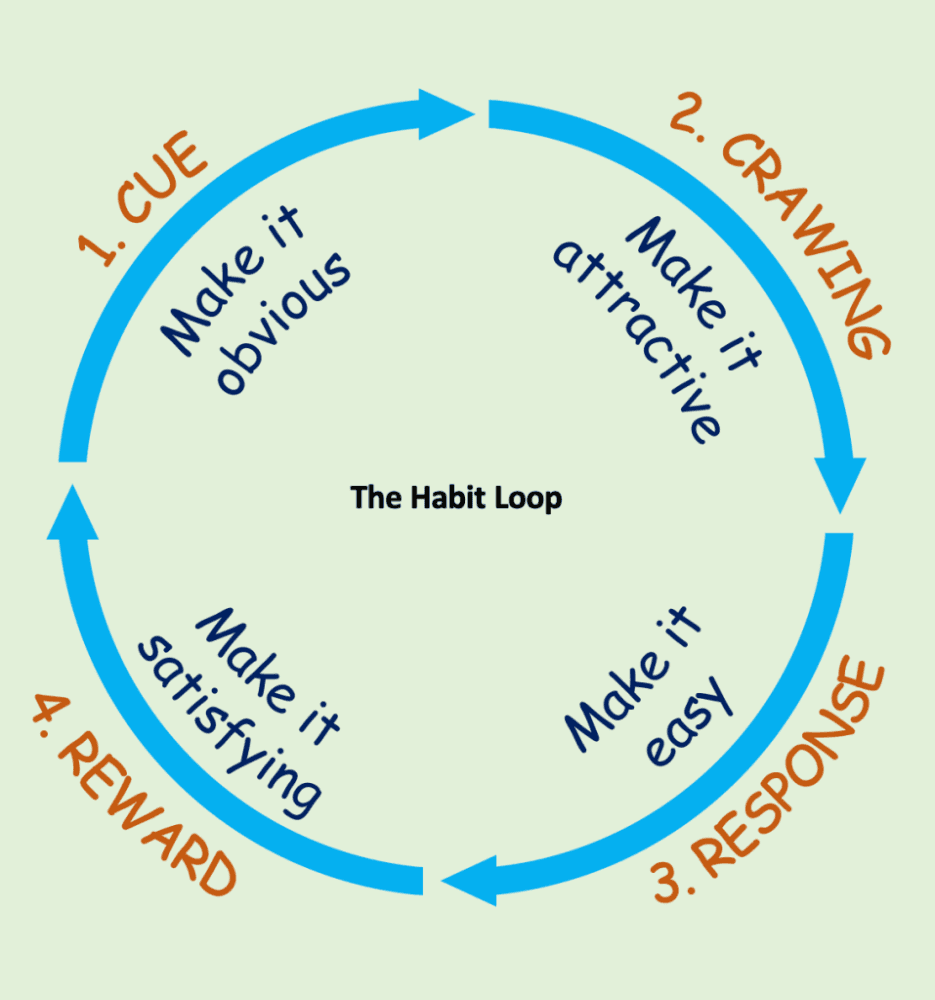
Clear’s book breaks habit formation into four simple steps: cue, craving, response, and reward. This habit loop creates a neurological feedback loop that makes behaviours automatic over time.
His Four Laws of Behaviour Change provide a practical framework:
Make it obvious (Cue) — Design your environment to trigger good habits
Make it attractive (Craving) — Bundle habits with things you enjoy
Make it easy (Response) — Reduce friction to make the habit simple to start
Make it satisfying (Reward) — Give yourself immediate positive feedback
These principles work. The problem isn’t the framework, it’s the context.
What’s Missing: The Social Dimension
Clear emphasizes that “you do not rise to the level of your goals. You fall to the level of your systems.” This is absolutely true. But what he doesn’t fully explore is that your social environment is part of that system.
Think about it: every example in the book assumes you’re building habits alone. You’re designing your environment. You’re tracking your progress. You’re celebrating your wins. But humans aren’t solitary creatures, we’re deeply social beings who’ve evolved to learn, grow, and change in groups.
Social cognitive theory, developed by Albert Bandura, demonstrates that people learn behaviors by observing and modeling others’ attitudes, emotions, and behavior. When we try to build habits in complete isolation, we’re ignoring one of the most powerful forces in behavioral change: social influence.
This is where community habits come in.
Why Gen Z Needs Accountability Systems (Not Just Habit Tracking)
Gen Z isn’t lazy or uncommitted. They’re overwhelmed.
Despite an overwhelming news cycle, Gen Z actively consumes news more than any other type of content — they feel a strong sense of accountability for shaping the future. This constant engagement comes at a cost: 6 in 10 Gen Z report feeling overwhelmed by events happening in their community, country, and the world.
When you’re already overwhelmed, adding another solo habit to your plate feels impossible. This is why traditional habit-tracking apps fail for this generation. They don’t need another thing to manage alone, they need systems that lighten the load through shared accountability.

What Gen Z Actually Values
Research reveals four key qualities Gen Z seeks in accountability systems:
1. Collective Accountability, Not Individual Pressure
Nearly 75% of young people say accountability is an important quality for any organization they join. But here’s the nuance: they want mutual accountability, not top-down pressure.
45% of young people say that if a leader isn’t accountable, they can’t trust the organization they lead, and 66% believe in taking responsibility for their mistakes and trying to resolve them. Gen Z wants to be held accountable, but they also want the systems and leaders around them to be equally accountable.
2. Autonomy With Structure
Gen Z thrives when they understand expectations and have the freedom to meet them in a way that suits their working style. They don’t want to be micromanaged, but they also don’t want to be left completely directionless.
This means accountability systems need clear goals and milestones, but flexible paths to achieve them. Think: “You need to post progress three times this week” rather than “You must post at 9 AM every morning.”
3. Immediate Feedback, Not Annual Reviews
Gen Z expects consistent coaching — they don’t want to wait for annual reviews. They want feedback that’s timely, honest, and focused on growth.
In habit formation, this translates to real-time recognition. When someone posts their progress, they want to see reactions, comments, and encouragement immediately, not weeks later in a monthly check-in call.
4. Community, Not Competition
Gen Z grew up on social media, but they’re increasingly sceptical of platforms that promote comparison and competition. Instead, they crave authentic connection and mutual support.
Understanding this social dimension allows for a more strategic approach to change. Making sustainable habits visible and sharing experiences creates a ripple effect that extends far beyond individual impact.
The Three Principles of Community Habits
Now let’s translate Clear’s individual framework into a community context. Think about how this changes the Four Laws:
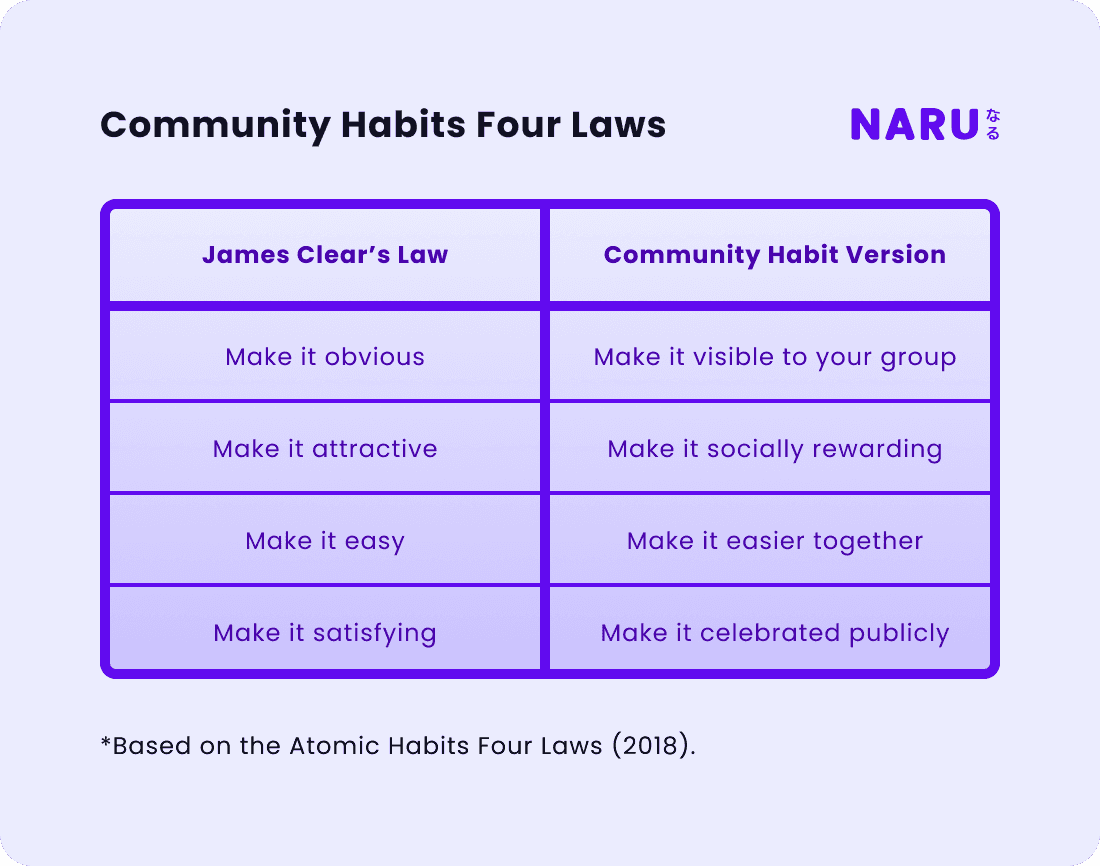
If we focus on the first 3 Atomic Habits laws, there are three principles that make habits stick for groups, especially Gen Z.
Principle #1: Make Habits Social (The Visibility Effect)
Clear’s first law is “make it obvious.” For community habits, we take this further: make it visible to others.
Research shows that habits developed with social accountability are 3.4 times more likely to stick than those attempted alone. A 2025 study found that when leaders visibly practised habits themselves, team members adopted those same habits at dramatically higher rates, a phenomenon called the “leadership contagion effect.”
But it’s not just about seeing leaders model behaviour. It’s about seeing peers do it.
How This Works in Practice
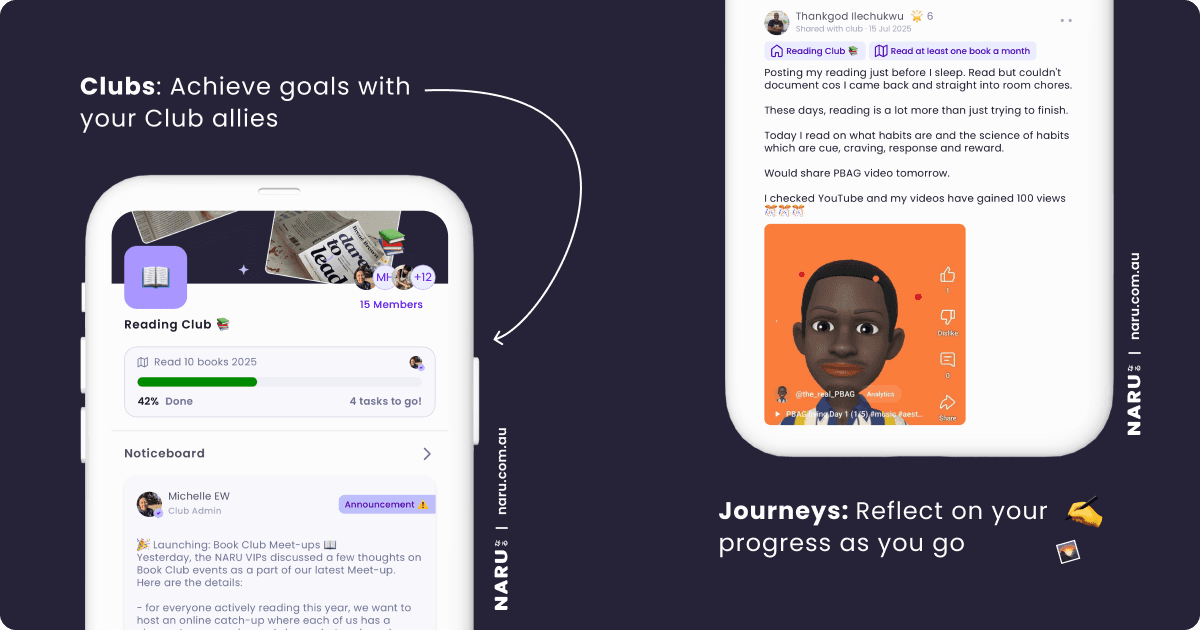
Instead of tracking your habit in a private app, you post your progress in a small group (5–15 people) working toward similar goals. This creates several powerful psychological effects:
Behavioural Modelling — Seeing peers consistently log workouts or share daily progress normalises the behaviour
Conformity Pressure — Unspoken norms (like posting a weekly summary) create silent expectations to participate
Vicarious Reinforcement — Watching others succeed motivates you to keep going
When your habit is visible to others, you’re not just building a personal routine — you’re contributing to a shared culture of growth.
Principle #2: Build in Peer Accountability (The Ally System)
Clear talks about environment design: removing temptations and optimizing for success. But there’s one element of your “environment” that’s more powerful than any physical setup: the people around you.
Studies have shown that if you are held accountable to someone else for meeting a goal, your chance of success increases dramatically. Weight loss groups witness members achieving better results due to the collective accountability factor.
But here’s the key: this only works when accountability is mutual.
The Ally System in Action
Instead of trying to build habits alone (or with a coach who just checks in on you), pair with a peer — an “Ally”: who’s working on their own goals. You hold each other accountable, not in a judgmental way, but in a supportive “we’re in this together” way.
Here’s why this works:
Reciprocity — When someone invests in your success, you feel obligated (in a good way) to invest in theirs
Shared Struggle — Knowing someone else is fighting the same battles makes your own struggles feel less isolating
Mutual Celebration — Wins feel bigger when someone else is genuinely excited for you
This transforms Clear’s “response” stage of the habit loop. Instead of:
Cue → You notice it’s time for your habit
Response → You do the habit alone
Reward → You check it off your list
You get:
Cue → Your Ally sends you a check-in message
Response → You do the habit and share progress
Reward → Your Ally celebrates with you + you see their progress too
The accountability becomes the reward.
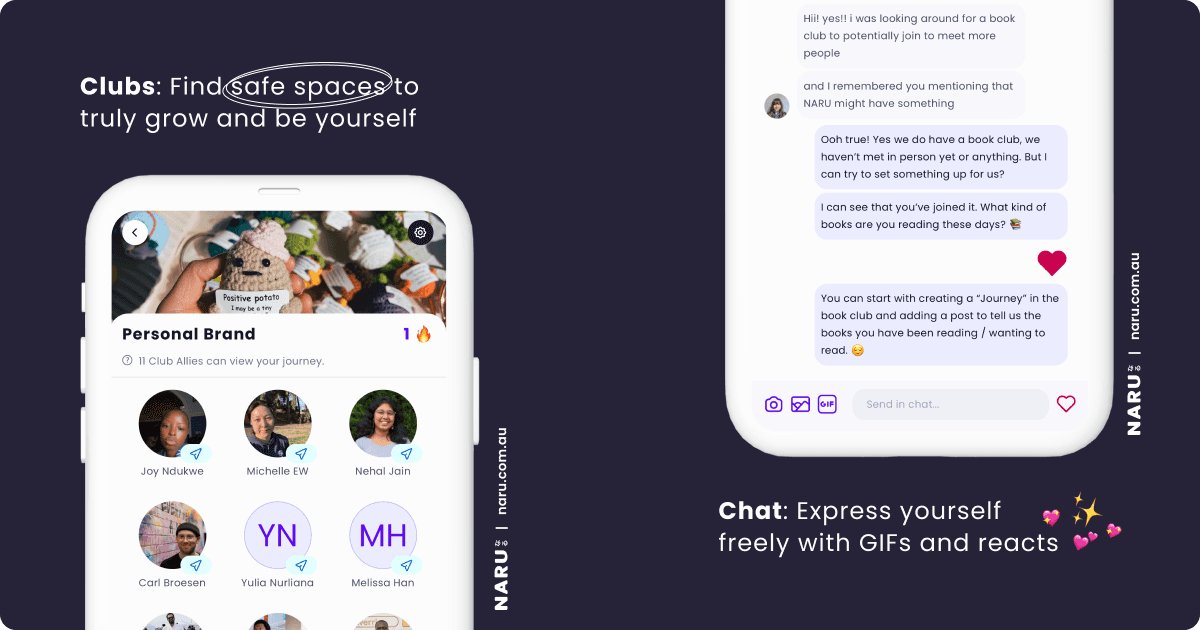
Principle #3: Design for Forgiveness, Not Perfection (The Grace Period System)
Clear emphasizes making habits easy to start, the “two-minute rule” where you scale down to something ridiculously simple. But he’s less explicit about what happens when you inevitably miss a day.
This is where most people fail. They build a 30-day streak, miss one day, and feel so discouraged that they give up entirely.
For Gen Z, a generation already overwhelmed by constant demands, perfectionist accountability systems are doomed to fail.
The Grace Period Innovation
Instead of an all-or-nothing streak system, build in forgiveness. Here’s how:
You commit to posting progress updates regularly (daily or weekly, depending on the goal). Every consecutive post builds your streak. But if you miss a post, you have 72 hours to catch up before the streak resets.
This changes everything:
Reduces All-or-Nothing Thinking — Missing one day doesn’t erase weeks of work
Acknowledges Reality — Life isn’t perfectly linear; systems should reflect that
Maintains Momentum — People keep going instead of starting over from zero
Builds Sustainable Habits — Long-term consistency matters more than perfect execution
This is Clear’s “make it easy” law applied to recovery. The easier it is to bounce back from a missed day, the more likely you’ll stick with the habit long-term.
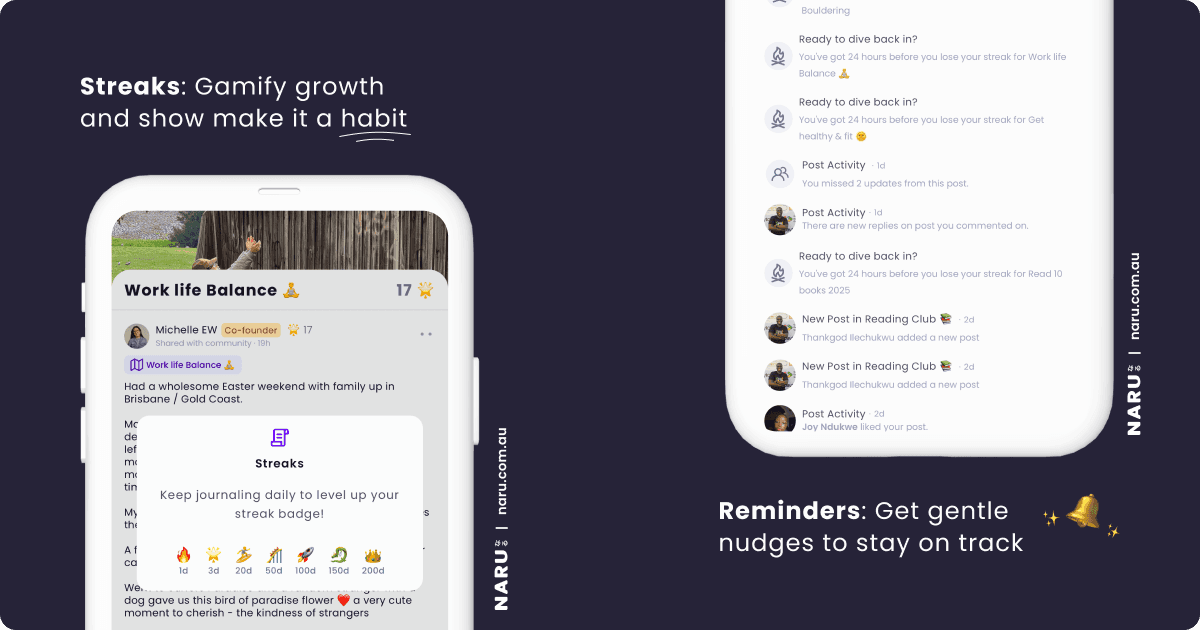
How to Implement Community Habits: A Practical Framework
Ready to build habits that actually stick? Here’s how to translate these principles into action, whether you’re building habits for yourself, your team, or a learning community.
Step 1: Start With Identity-Based Habits (Clear’s Best Insight)
Clear’s key insight is that the best way to change behavior is to focus on who you wish to become, not what you want to achieve. Your identity emerges from your habits, every action is a vote for the type of person you wish to become.
For community habits, ask:
“What kind of person am I becoming through this community?”
“What kind of group do we want to be?”
For example:
Instead of “I want to lose weight,” think “I’m becoming a healthy person”
Instead of “We want to finish this course,” think “We’re becoming people who follow through”
Step 2: Form Small Accountability Groups (5–15 People)
Don’t try to build habits with 100 people at once. Small cohorts of 5–10 participants who meet regularly under guidance show the highest success rates.
Your group should be:
Small enough for everyone to know each other by name
Focused enough that everyone is working on related goals
Active enough that members post progress multiple times per week
Supportive enough that failure is met with encouragement, not judgment
Step 3: Pair Members as Allies
Within your small group, create even smaller pairs, Allies who check in with each other specifically.
Give them a simple framework:
Weekly Goal Check-In — “What are you working on this week?”
Mid-Week Nudge — “Hey, how’s it going with [specific goal]?”
Weekend Review — “How did this week go? What’s your plan for next week?”
Make this mandatory, not optional. The students who opt out are the ones who will drop out.
Step 4: Implement Visible Progress Tracking
Use Clear’s “make it obvious” principle at the group level:
Public Progress Posts — Members share wins, challenges, and lessons learned
Streak Counters — Display consistency visibly (with opt-in for privacy)
Milestone Celebrations — Recognise when people hit 7, 30, 60, 90-day marks
Weekly Summaries — Highlight top contributors and shared wins
The key is making progress socially visible so that:
People feel accountable to the group
Successes are celebrated publicly
Others are inspired by what’s possible
Step 5: Build in the 72-Hour Grace Period
Never use an all-or-nothing streak system. Always include forgiveness:
If someone posts their habit update, their streak continues
If they miss their usual post day, they have 72 hours to catch up
If they post within the grace period, their streak stays intact
If they don’t post within 72 hours, the streak resets (but they’re encouraged to start again immediately)
This single feature prevents the “I’ve already failed, so why bother continuing” mindset that kills habit formation.
Step 6: Scale Accountability to Goal Size
Not all habits need the same level of accountability:
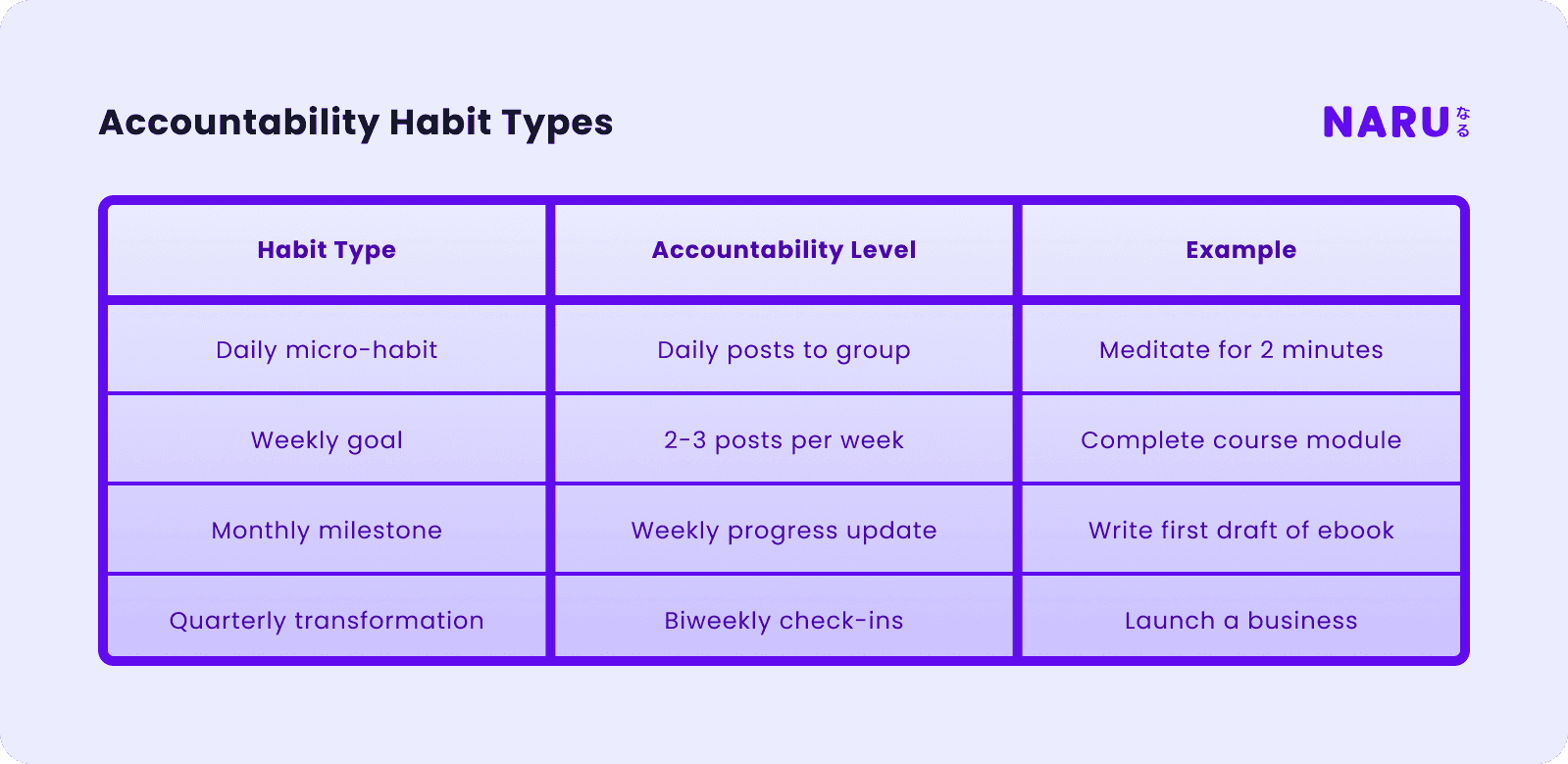
Match the frequency of accountability to the scope of the goal. Too much for small habits feels like overkill. Too little for big goals leads to drift.
Real-World Example: How NARU Implements Community Habits
Let’s make this concrete with a real example.
Imagine you’re a course creator running a 12-week cohort on building a freelance business. You have 40 students who paid $997 each. Historically, only 15% finish the course.
Traditional Approach (What Fails)
Students watch pre-recorded videos on their own time
They’re encouraged to “join our Facebook group”
Maybe there are weekly office hours (that 10% attend)
Students work in isolation, fall behind, quit quietly
Result: 6 students finish. You get a few refund requests. No testimonials. Can’t use this cohort to sell the next one.
Community Habits Approach
Week 1: Identity Formation
Cohort starts together on January 15
Everyone introduces themselves in a dedicated “launch week” thread
They’re asked: “Who do you want to become through this program?” (not “What do you want to achieve?”)
Students are organised into 8 small Clubs of 5 people each, grouped by similar goals
Ongoing: The Ally System
Each student is paired with one Ally from their Club. Allies exchange contact info and commit to weekly check-ins:
Monday: “What’s your focus this week?”
Wednesday: “How’s progress?”
Sunday: “Reflect on wins and challenges”
Ongoing: Visible Progress
Each Club has a dedicated space where members post:
Weekly progress updates (minimum 1 per week)
Questions or challenges they’re facing
Wins (even small ones) they want to celebrate
The course creator highlights 5–10 standout posts each week in a “Community Wins” email
Ongoing: Streak Tracking with Grace
Students who post progress weekly build their “consistency streak”
Streak count is displayed to gamify the habit
72-hour grace period means missing one post doesn’t destroy momentum
After 30 days, 60 days, 90 days, special milestone badges are awarded
Result
35 of 40 students finish (88% completion rate)
You have 30+ testimonials and case studies
Students refer friends because they had an amazing experience
You can charge more for the next cohort because you have proof it works
What changed? The course content was the same. But the structure transformed isolated learners into a community of people accountable to each other.
Why This Matters More Than Ever in 2026
We’re living in an era of infinite information and zero follow-through.
Everyone has access to the same courses, books, and frameworks. James Clear’s insights are available to anyone with an internet connection. But knowing what to do doesn’t mean doing it.
The question is: What system do you have?
For Gen Z — a generation that demands transparency, accountability, and meaningful connection from every organization they join, isolated habit-tracking isn’t enough. They need systems that combine:
Clear’s individual frameworks (cue, craving, response, reward)
Social accountability (Allies, visible progress, peer support)
Forgiveness-based design (grace periods, recovery protocols)
When you build these three elements together, you don’t just create habits, you create community habits that transform groups of individuals into movements of people who actually follow through.

The Bottom Line: Atomic Habits Meet Social Accountability
James Clear revolutionised habit formation by making it feel achievable. His framework works.
But habits built alone are fragile. Habits built with community are resilient.
The future of behaviour change isn’t solo habit tracking apps with gamification. It’s community-driven accountability systems that combine Clear’s individual insights with the social dynamics that make us human.
For course creators, community builders, and anyone trying to help people actually achieve their goals: the framework is simple.
Start with identity — Who are we becoming?
Build Ally pairs — Who’s holding me accountable?
Make progress visible — Who sees my work?
Design for recovery — What happens when I miss a day?
Celebrate together — Who shares my wins?
When you implement these five elements, something remarkable happens. Your community doesn’t just consume content, they transform. Together.
Because in the end, we don’t rise to the level of our goals. We fall to the level of our systems.
And the strongest systems are the ones we build together.
Ready to Build Community Habits?
NARU is built on the principles from James Clear’s Atomic Habits, designed specifically for communities that want to achieve goals together. With built-in Allies, visible progress tracking in Clubs, streak mechanics with a 72-hour grace period, and analytics to measure consistency, NARU provides the accountability infrastructure your community needs.
Whether you’re running cohort-based courses, building habit programs, or leading goal-oriented communities, NARU gives your members the structure James Clear recommends, plus the social accountability he didn’t explicitly address.
Want to see it in action? Join our global community to experience NARU’s community habit system firsthand, or schedule a strategy session to discuss building accountability into your program.
Stay healthy & gold,
Co-founder & Product @ NARU