📉 Why 95% of Online Courses Fail (And the 3 Ingredients That Get Students to Finish)

Greetings, Trailblazers! 🌟
Many community builders are stuck with one looming fact: Online courses have 12.6% median completion rates. Yes, you read that right.
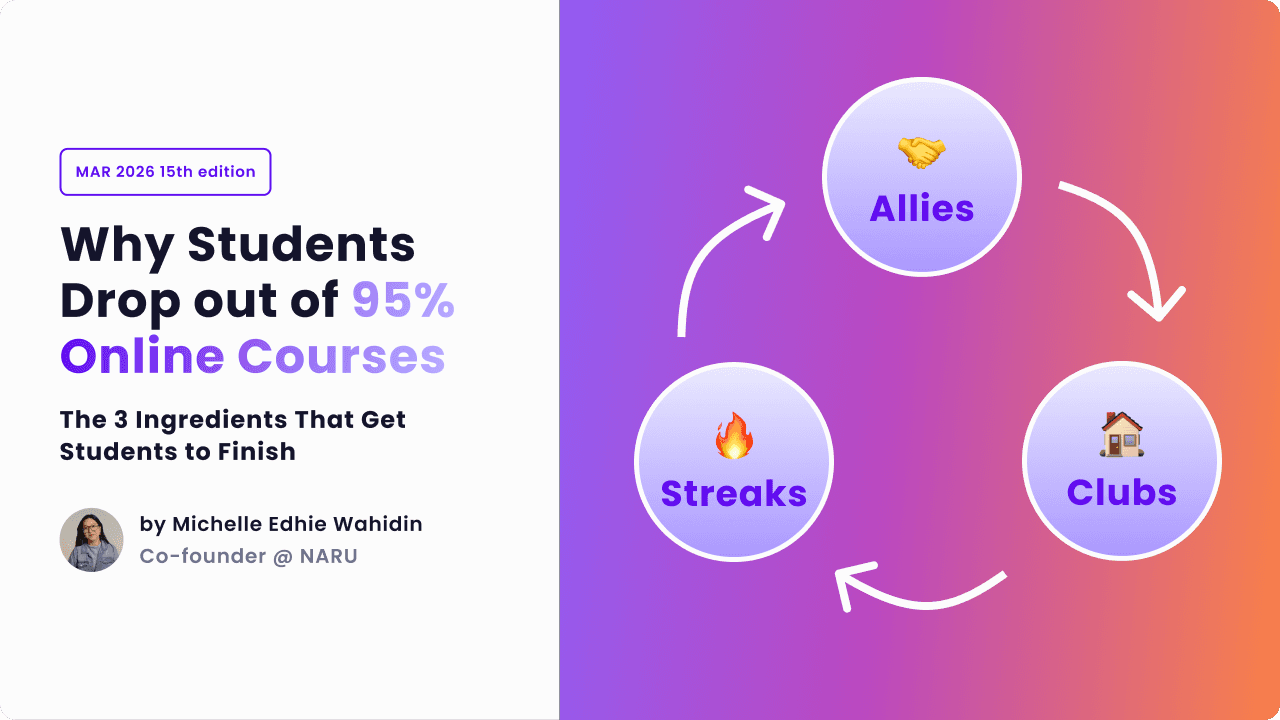
In our 15th edition of the NARU Newsletter, we'll be sharing 3 proven ingredients that have helped our cohort-based courses achieve 90%+ completion: peer accountability, public progress tracking, and smart streak mechanics.
You’ve spent months creating your online course. The content is solid. The videos are polished. Your sales page promises transformation. Students sign up, credit cards are charged, and then… crickets.
Three weeks later, your course dashboard tells a brutal story: 88% of students haven’t logged in since Week 1. The few who remain active are scattered across different modules, moving at different paces, quietly losing momentum. By the end of the cohort, maybe 5–10% will actually finish.
If this sounds familiar, you’re not alone. The uncomfortable truth is that most online courses fail to deliver on their promise, not because the content is bad, but because the structure is broken.
The Course Completion Crisis Nobody Talks About
Let’s start with the data that should terrify every course creator:
Online course completion rates range from 0.7% to 52.1%, with a median completion rate of just 12.6%. That means 88 out of every 100 students who enroll in your course will never finish it.
For massive open online courses (MOOCs) on platforms like Coursera and edX, the statistics are even bleaker. Among all MOOC participants, only 3.13% completed their courses in 2017–18, and completion rates have been declining year over year.
Even more shocking? 52% of people who register for an online course never even look at the courseware, and dropout rates reach 96% on average over five years.
Think about what this means for your business:
Lost revenue from refund requests when students realize they’re not making progress
Damaged reputation when students don’t get results they can share
No testimonials or success stories to attract new customers
Wasted time and money creating content nobody finishes
Guilt knowing you couldn’t help the people who trusted you
But here’s what keeps course creators up at night: your students wanted to succeed. They paid you. They showed up. They had real goals and dreams. And somehow, the way we’ve been teaching online has failed them.
The question is: why?
The 3 Fatal Flaws Killing Course Completion Rates
Fatal Flaw #1: Isolation Destroys Motivation
When you learn alone, you fail alone.
One of the most common reasons students abandon online courses is social isolation, which causes loss of motivation. Think about it: when was the last time you stuck with something difficult, boring, or challenging completely on your own with zero accountability?
Self-paced learning sounds great in theory. “Learn on your own schedule!” “Go at your own pace!” But in practice, it translates to:
No deadline urgency
No peer pressure
No one to notice if you skip a week
No community to celebrate wins with
No accountability when life gets busy
Students start with enthusiasm, but when they hit their first obstacle: a confusing module, a busy work week, a family emergency, there’s no one there to help them push through. They tell themselves “I’ll catch up later,” and later never comes.
The research backs this up. When you learn something passively, there’s a 72% chance you’ll forget it. But when you use it, answer questions about it, and interact with others, there’s a 69% chance you’ll remember it.
Learning is fundamentally social. We evolved to learn in groups, from mentors, through apprenticeship and shared experience. Online courses that ignore this basic human need are fighting against millions of years of evolution.

Fatal Flaw #2: Self-Discipline Is a Limited Resource
Course creators often blame students for lacking discipline or motivation. But that’s not fair, and it’s not accurate.
Students who expect to breeze through online classes or think doing work on their own schedule means devoting little time to studies often find themselves struggling. The reality is that most students don’t understand what they’re signing up for.
Consider this: Students should expect to spend at least 15 hours a week for each three-credit course they take. That’s in addition to their jobs, families, and other responsibilities.
According to research, at least 40% of undergraduate students and 76% of graduate students work at least 30 hours a week. When you add course time to work time, plus family obligations, the numbers simply don’t add up.
But the deeper issue is this: self-discipline is not an unlimited resource. It depletes throughout the day. By the time your student finishes work, makes dinner, helps kids with homework, and finally sits down at 9 PM to watch your course videos, their willpower tank is empty.
Without external structure: deadlines, check-ins, accountability partners, even the most motivated students will eventually skip “just this one module” and never catch up.

Photo by ROBIN WORRALL on Unsplash
Fatal Flaw #3: Content Without Context Doesn’t Stick
Here’s a painful truth for course creators: information alone doesn’t create transformation.
Your students are drowning in information. They can Google anything. Watch YouTube tutorials for free. Access thousands of courses on Udemy. Anyone can go on Google and find close to a million free lectures at their fingertips.
What they can’t Google is:
Someone to explain why this specific piece applies to their unique situation
Real-time feedback on their implementation
Answers to the questions they don’t know how to ask
Encouragement when they’re ready to quit
Proof that this actually works for people like them
When students watch your pre-recorded lectures in isolation, they’re consuming content, not experiencing transformation. There’s no discussion, no debate, no moment where a peer asks a question that makes everything click. Just passive consumption and the hope that somehow, magically, they’ll apply it later.
They won’t.

Photo by Zulfugar Karimov on Unsplash
The Completion Rate Revolution: Why Cohort-Based Learning Changes Everything
Now let’s talk about what actually works.
While traditional online courses struggle with completion rates below 15%, there’s a different model quietly achieving results that seem almost impossible:
Cohort-based learning programs are achieving 85–96% completion rates.
Read that again. Not 15%. Not 30%. Up to 96%.
Real examples:
Students in Esme Learning’s cohort-based learning courses are showing completion rates of 98–100%
Nomadic Learning achieves over 90% completion rate regularly in their cohort-based programs
These aren’t flukes. They’re proof that when you change the structure, you change the outcomes.
So what makes cohort-based learning so effective? Three ingredients that directly counter the three fatal flaws we identified earlier.
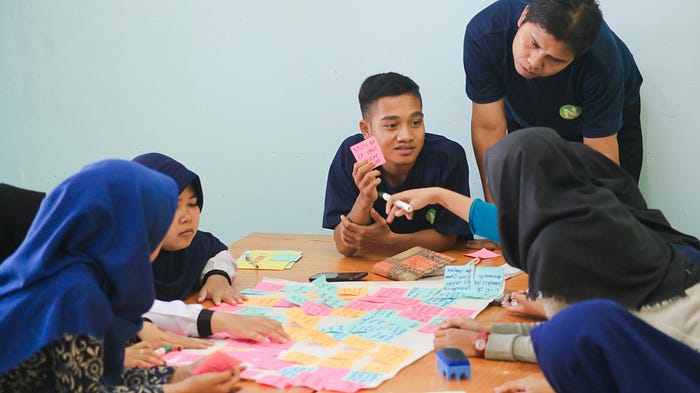
Photo by Zainul Yasni on Unsplash
The 3 Ingredients That Get Students to Finish (And Actually Transform)
Ingredient #1: Peer Accountability (The Ally System)
The first ingredient is simple but powerful: pair your students with accountability partners who check in on their progress.
This solves the isolation problem head-on. Instead of learning alone, students now have:
Someone who notices when they miss a week
A peer who shares their struggles and wins
A partner who depends on them to show up
Mutual accountability that makes quitting harder
Think about James Clear’s insight from Atomic Habits: “You don’t rise to the level of your goals. You fall to the level of your systems.” An accountability partner is the system.
Here’s how it works in practice:
When Sarah signs up for your course on the 15th of January alongside 40 other students, she’s immediately paired with another student, let’s call her Maria. They become “Allies” with a shared mission: help each other finish.
Throughout the course:
They check in weekly on progress
They troubleshoot problems together
They celebrate small wins
They hold each other accountable to posting updates
When Sarah hits a difficult module in Week 3, she can’t just quietly disappear. Maria is expecting her update. Maria is counting on her. And when Sarah sees Maria pushing through her own challenges, it inspires her to do the same.
The research is clear: 58% of online cohort members agreed that relationships with classmates encouraged them to continue with the program, and 94% stated that discussions increased their interest in course issues.
Peer accountability turns course completion from an individual challenge into a team sport. And humans are hardwired to show up for their team.

Photo by Ryan Snaadt on Unsplash
Ingredient #2: Public Progress (The Club System)
The second ingredient is creating small groups where students share their progress publicly.
Remember the self-discipline problem? Here’s the solution: make progress visible and create social pressure (the good kind).
Instead of students working in isolation, they join small “Clubs” of 5–15 people working toward similar goals. These aren’t passive Facebook groups. They’re active learning communities where:
Members post daily or weekly progress updates
Everyone can see who’s showing up and who’s falling behind
Students get real-time feedback from multiple perspectives
Success is celebrated publicly, creating positive momentum
This taps into a powerful psychological principle: public commitment increases follow-through.
When you privately decide to work out more, you can quietly abandon it without consequence. But when you tell your gym class you’re training for a 5K and they start asking about your progress each week, suddenly you’re lacing up your running shoes at 6 AM.
The Club system creates this dynamic at scale. Students aren’t just accountable to one person, they’re accountable to their entire Club. They see others making progress, which motivates them. They see others struggling with the same issues, which normalizes the difficulty. They see others asking questions, which gives them permission to ask their own.
This is why traditional online courses fail and why learning communities succeed: visibility breeds accountability, and accountability drives completion.

Photo by Chris Montgomery on Unsplash
Ingredient #3: Streak Mechanics with Grace (The 72-Hour Rule)
The third ingredient is the smartest: build in habits with forgiveness built into the system.
Here’s where most accountability systems fail: they’re too rigid. Miss one day and your streak is gone. Fall behind once and you’re so far back you might as well quit.
This is where streak mechanics: borrowed from the best habit-tracking apps, combine with human psychology to create sustainable progress.
The system works like this:
Students commit to posting progress updates regularly (daily or weekly, depending on the goal). Every consecutive post builds their “streak.” The longer the streak, the more invested they become in maintaining it.
But here’s the crucial innovation: the 72-hour grace period.
Life happens. Kids get sick. Work gets crazy. Your internet goes down. Instead of destroying your 42-day streak because you missed one day, you have a 72-hour window to post your update before the streak resets.
This single feature changes everything because it:
Removes the all-or-nothing pressure that kills motivation
Acknowledges that life isn’t perfectly linear
Maintains momentum instead of forcing students to start over
Builds long-term habits instead of unsustainable sprints
Think about it: if you’re on Day 30 of a streak and you miss one day, what happens in most systems? You’re back to Day 0. That’s devastating. Most people quit right there.
But with a 72-hour grace period, missing one day doesn’t erase a month of work. You have time to get back on track, and your progress is preserved. The result? Students keep going instead of giving up.
This is habit formation based on actual human behavior, not idealized perfection. And it works.

Photo by Prophsee Journals on Unsplash
How to Build a Course People Actually Finish: The NARU Framework
Now let’s tie this together into a practical framework you can implement.
Whether you’re running courses on Udemy, Coursera, YouTube, or any other platform, you can layer a community accountability system on top to dramatically improve completion rates.
Here’s the step-by-step approach:
Step 1: Shift to Cohort Launches
Stop the “always open” enrollment model. Instead:
Set specific start dates (e.g., every quarter or every month)
Enroll a fixed group of 20–50 students who start together
Everyone moves through the material on the same timeline
Create clear milestones and deadlines for the cohort
This creates urgency, peer awareness, and collective momentum. Students know they’re part of a specific group with a shared start and finish line.
Step 2: Pair Students as Allies
On Day 1, assign accountability partners:
Match students with similar goals or complementary strengths
Give them a simple framework for weekly check-ins
Encourage them to exchange contact info (email, phone, WhatsApp)
Create expectations: “Your Ally is counting on you to show up”
Make this mandatory, not optional. The students who opt out of having an Ally are the ones who will drop out.
Step 3: Create Small Clubs for Public Progress
Organize your cohort into small groups of 5–15 people:
Give each Club a specific focus or theme
Require members to post progress updates (daily or weekly)
Enable reactions and comments so students engage with each other
Highlight top contributors to model the behavior you want
The goal is to make progress visible and create positive peer pressure. When everyone else is posting their wins and challenges, falling silent becomes uncomfortable.
Step 4: Implement Streak Mechanics with Grace
Build a streak system that rewards consistency:
Track consecutive progress posts
Display streak counts publicly (if students opt in)
Give a 72-hour grace period for life’s interruptions
Celebrate milestone streaks (7 days, 30 days, 60 days)
This gamification element taps into our natural love of progress bars and winning streaks. It makes showing up feel rewarding, even on hard days.
Step 5: Layer This Onto Your Existing Course
Here’s the best part: you don’t need to rebuild your course from scratch.
Keep your course content on whatever platform you’re using (Udemy, Teachable, YouTube, Coursera). But add a community layer using a platform designed for accountability:
Your students watch the course videos on the course platform
They share progress, ask questions, and connect with Allies on the community platform
The community becomes the glue that keeps them engaged with your content
This is how you can run a $50K cohort course using free or low-cost tools plus one smart accountability platform.
The Real Cost of Low Completion Rates (And What High Completion Unlocks)
Let’s talk money, because this isn’t just about feel-good metrics.
When students don’t finish your course, you lose:
Refund revenue — Students who don’t see results request refunds
Testimonials — No finishers = no success stories = harder to sell the next cohort
Word-of-mouth — Incomplete students don’t refer friends
Upsell opportunities — Can’t sell advanced courses to people who didn’t finish the first one
Your reputation — Low completion rates eventually leak into reviews and perception
But when students actually finish and get results?
Case studies — Real transformations you can showcase
Referrals — Happy students bring their friends
Premium pricing — Proven results justify higher prices
Expansion — Launch advanced courses, coaching, or communities
Impact — You actually help people change their lives (which is probably why you started)
72% of individuals who successfully finish courses report career benefits, while 61% report educational benefits. These students become your best marketers.
The math is simple: A $997 course with 90% completion is worth more than a $2,997 course with 10% completion.
Not just financially — though the lifetime value is higher. But because impact compounds. Every student who finishes becomes a reference point for the next cohort. Every success story attracts better students. Every result validates your expertise.
High completion rates aren’t vanity metrics. They’re the foundation of a sustainable course business.
Photo by Joel Mott on Unsplash
The Bottom Line: Structure Beats Motivation
If 95% of your students aren’t finishing your course, it’s not because they’re lazy or uncommitted.
It’s because the structure is designed for failure.
Self-paced. Isolated. Without accountability. Without peer support. Without streak mechanics. Without grace for being human.
The three ingredients that fix this are simple:
Allies — Peer accountability partners who check in and support each other
Clubs — Small groups where progress is public and visible
Streaks — Habit mechanics with a 72-hour grace period for sustainability
When you implement these, something remarkable happens: your completion rates don’t just improve, they skyrocket. From 5–15% to 85–96%.
Your students actually finish. They get results. They refer their friends. They buy your advanced courses. They send you tearful thank-you emails about how you changed their lives.
And you get to build a course business that doesn’t just sell access to content, but actually delivers transformation.
Because at the end of the day, that’s what you signed up for, not to create more content that sits unwatched in someone’s course library, but to genuinely help people achieve goals they couldn’t reach alone.
The tools exist. The research is clear. The only question is: are you ready to stop creating courses that fail and start building learning experiences that actually work?
Ready to Build a Goal-Driven Learning Community?
NARU is a community platform built specifically for accountability-driven learning. With built-in Allies, Clubs, streak tracking with a 72-hour grace period, and analytics to track completion rates, it’s designed to help course creators achieve 90%+ completion rates.
Whether you’re running cohort-based courses, habit-building programs, or goal-oriented communities, NARU provides the structure your students need to actually finish what they start.
Want to see how it works? Join our global community to experience NARU firsthand, or schedule a strategy session to discuss building your own accountability-driven course.
Stay healthy & gold,
Co-founder & Product @ NARU